

BASTION
Directed Energy C-UAS at $1 Per Shot
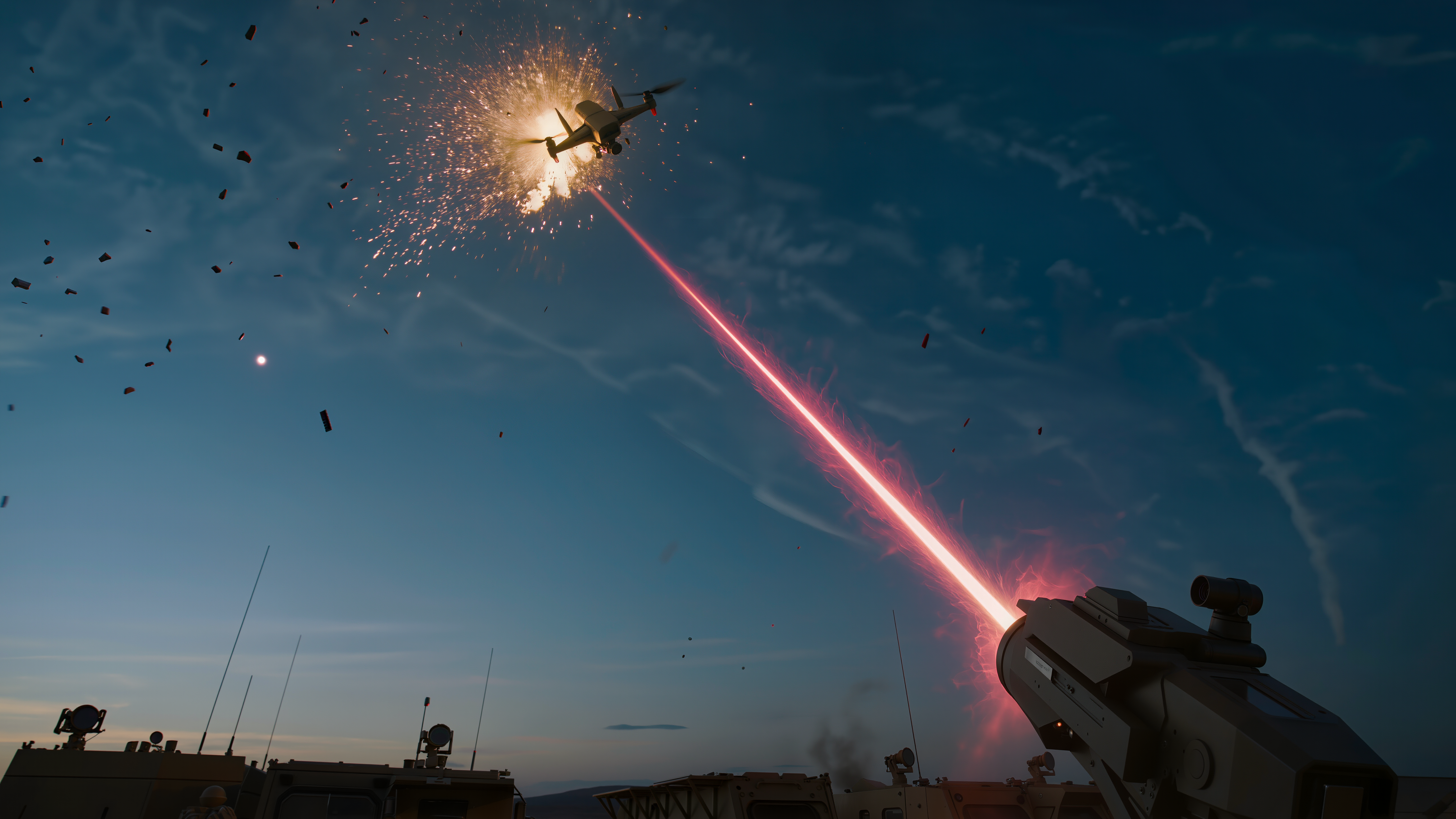
The drone swarm threat has inverted the cost equation of modern warfare. Silent Shield exploits a fundamental physics advantage, Ohm's Law vs. the Rocket Equation, to deliver 100kW directed energy engagement at the speed of light, with unlimited magazine depth.
The Economics of Drone Defense Are Fundamentally Broken
Commercial drones costing $500-$5,000 are destroying armored vehicles worth millions.
The Cost Asymmetry Crisis
Commercial drones costing $500-$5,000 are destroying armored vehicles worth millions. FPV drones in Ukraine cost under $500 each. A Stinger missile costs $38,000. A Patriot interceptor costs $2-4 million. The defender faces a cost-exchange ratio that is unsustainable at any scale.
When an adversary can field thousands of drones at $1,000 each, no amount of kinetic interceptors can keep pace. The DoD has identified C-UAS as one of its top five capability gaps. Over 40 countries now operate military drone programs.
The Arithmetic of Defeat
A 10-cell launcher vs. a 50-drone swarm is defeated by basic math. Kinetic systems have finite magazine depth and reload times. Directed energy changes the equation entirely, engage targets at 3-5 second intervals, indefinitely.

Ohm's Law Defeats the Rocket Equation
Physics-based advantage using commercial fiber laser technology.
Coherent Beam Combining Array
Multiple 10-20kW commercial fiber laser modules coherently combined into a single 100kW+ beam via spectral beam combining and active phase control. Leverages the $7B commercial fiber laser market for cost-effective, high-reliability gain media.
AI-Driven Multi-Target Tracking
Multi-sensor suite (radar + EO/IR + acoustic) feeding an AI/ML tracking pipeline. Real-time detection, classification, and priority allocation across multiple simultaneous targets. Sub-2-second target acquisition.
Adaptive Beam Director
Gimbaled beam director with adaptive optics compensating for atmospheric turbulence, thermal blooming, and platform vibration at kilohertz rates. Shack-Hartmann wavefront sensor with 1,024-actuator deformable mirror.
Integrated Thermal Management
Closed-loop liquid cooling with phase-change thermal storage. Enables 60+ second burst operations and 50% sustained duty cycle. The thermal budget, not ammunition, is the only operational constraint.

A $12B+ Market Driven by an Existential Defense Need

10x Cost Advantage Over Defense Primes
vs. Raytheon HELWS (50kW)
$15-20M unit cost, slow scaling, bureaucratic acquisition. Silent Shield: $3-5M, modular scaling, lean development in 36 months vs. 7-10 years.
vs. Lockheed HELIOS ($100M+)
Navy-specific, ship-mounted only, extreme cost. Silent Shield is platform-agnostic from inception, vehicle, fixed-site, and naval integration.
vs. Rafael Iron Beam
Export-restricted, high cost, integrated with Israeli air defense only. Silent Shield targets the global allied market with FMS-friendly design.
AI-Native Architecture
Purpose-built AI tracking and fire control, not retrofitted legacy software. ML-driven threat prioritization, autonomous engagement sequencing, and predictive beam steering.

From Lab to Fielded Weapon System in 36 Months
Beam Combining & Tracking MVP
Demonstrate 50kW coherent beam combining with 4 fiber laser modules. Integrate AI tracking pipeline with EO/IR sensor. Bench-level engagement of static drone targets. TRL 4-5.
100kW Integration & Field Testing
Scale to 100kW with 8-module array. Adaptive optics integration. Vehicle-mounted prototype. Engage moving drone targets at 1-3km range. TRL 5-6.
TRL 6-7 Demonstration
Multi-target swarm engagement. 5km range demonstration. Integrated thermal management for sustained operations. DoD operational testing at Yuma Proving Ground.
LRIP & Deployment
Low-rate initial production. First unit delivery to U.S. Army or Marine Corps. FMS pipeline initiated with NATO allies. Scalable to 300kW for future naval variant.

From Forward Operating Bases to Critical Infrastructure
Forward Operating Base Defense
Fixed-site installation protecting FOBs, airfields, and logistics hubs from drone swarm attacks. Unlimited engagement capacity eliminates ammunition resupply vulnerability in contested environments.
Mobile Maneuver Force Protection
Vehicle-mounted (8x8 tactical vehicle) providing short-range air defense for maneuver elements. Integrates with existing SHORAD architecture. DE M-SHORAD program alignment.
Critical Infrastructure Protection
Power plants, water treatment facilities, airports, and government buildings. Silent operation with zero collateral damage risk makes DEW ideal for populated area defense.
Naval Point Defense
300kW naval variant for ship-mounted C-UAS and anti-surface warfare. Complements CIWS and missile defense with unlimited magazine depth against asymmetric swarm threats.

Physics-Based Advantage Using Commercial Fiber Laser Technology
System Architecture
Laser Source Layer
10-20kW commercial fiber laser modules (IPG, Trumpf), spectral beam combining with diffraction gratings, active phase control (SPGD algorithm), >40% wall-plug efficiency
Beam Director Layer
Shack-Hartmann wavefront sensor (2kHz), 1024-actuator MEMS deformable mirror, gimbaled telescope (60 deg/s az, 30 deg/s el), atmospheric pre-compensation
Fire Control Layer
Multi-sensor fusion (radar + EO/IR + acoustic), AI/ML classification pipeline, autonomous engagement sequencing, threat prioritization engine
Power & Thermal Layer
200kW diesel generator, closed-loop liquid cooling, phase-change thermal storage, 60s burst / 50% sustained duty cycle
Performance Specifications
- 100 kW beam power (scalable to 300 kW)
- 5 km effective range (Class 1-3 UAS)
- Sub-5-second effect time per target
- Near-diffraction-limited beam (M-squared < 1.5)
- Graceful degradation, 90% power with one module down
- Field-upgradable power scaling (add modules)
- Platform: 8x8 vehicle, fixed site, or naval mount
- ~$1 per engagement (electricity cost)
- Unlimited magazine depth (power-limited)
- All-weather adaptive optics compensation

Defense Prime Economics with Startup Speed
System Sales
Per-unit system cost, 75% below defense prime alternatives. Modular architecture enables field upgrades and variant configurations.
Service & Maintenance
Annual sustainment contract per system. Predictive maintenance, laser module replacement, software updates. 15-year system lifecycle.
AI Software License
Annual license for AI tracking and fire control software updates. Threat library updates, algorithm improvements, new target class profiles.